How many people are in the airport right now?
Business professor Adam Mersereau used mathematical models to answer a deceptively simple question with big implications.
Modern airports are awash in advanced technology, yet managers still struggle with a deceptively simple question: How many people are here right now?
The answer has implications for how smoothly the airport operates and the passenger experience.
In real-time, managers must decide when to deploy staff, what wait times to communicate to travelers and whether the airport is approaching capacity limits. They also need to run long-term planning scenarios for adding flights or making operational changes.
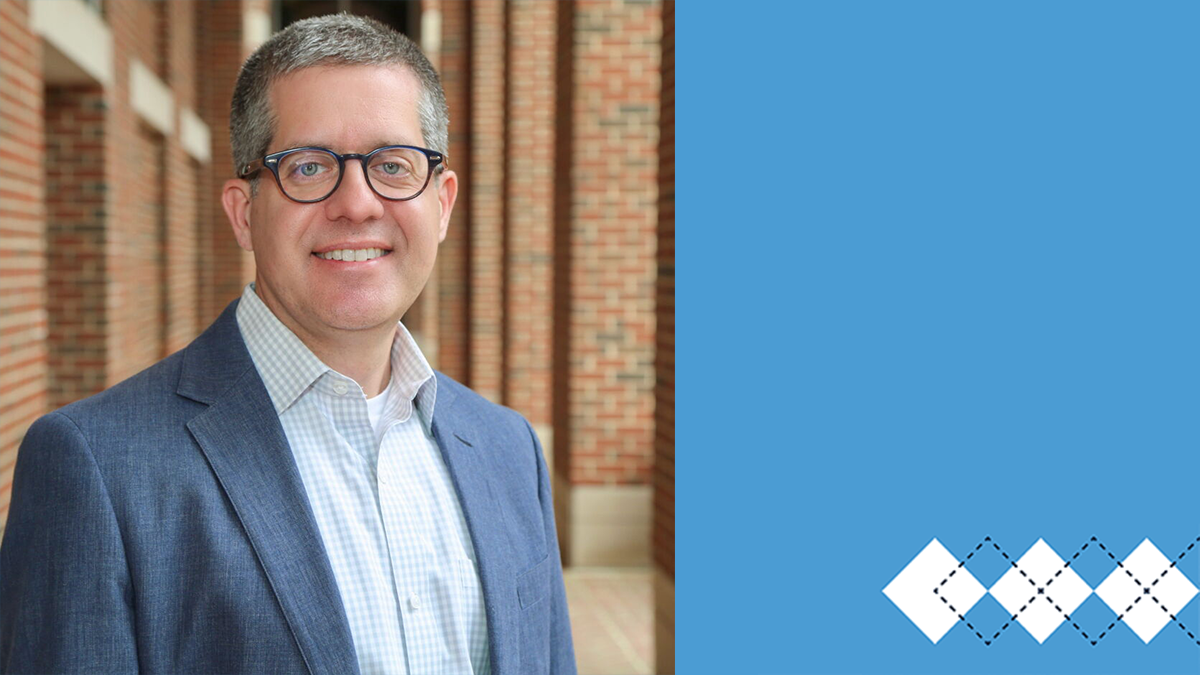
Adam Mersereau, UNC Kenan-Flagler Business School professor and area chair of operations, joined with some colleagues to address these challenges. They wanted to create mathematical models that — paired with people-counting sensors — estimate crowding in the security area without visual headcounts.
“We saw an opportunity to solve two problems at once,” says Mersereau, who is also a Sarah Graham Kenan Scholar. “Passengers would get accurate wait time estimates so they could time their arrivals better, and the airport would get better data for staffing and long-term planning.”
Mersereau worked with professor Serhan Ziya of the UNC College of Arts and Sciences’ statistics and operations research department and faculty from North Carolina Wesleyan and Duke universities.
They used Raleigh-Durham International Airport as their test case, but their research may also help managers at theaters, hospitals and concert arenas better anticipate and manage crowds.
The difficulties of counting the crowd
Mersereau’s expertise centers on operations at brick-and-mortar retailers, where managers might know what’s selling but not who’s coming in or whether the store is adequately staffed.
Airports pose a similar kind of problem, he says. Managers don’t necessarily know how many people are in a space at a point in time.
“It’s not just passengers waiting in lines, but also bags, planes and crews,” says Mersereau. “And with physical queues, it’s mostly guesswork. No one’s standing there with a clipboard tracking line length in real time.”
To come up with an accurate count, Mersereau and the team installed infrared beam sensors at the entrance and exit of the Transportation Security Administration area at the airport. Each time a passenger breaks the beam, the system logs either an entry or an exit. At any given moment, it tracks the total number of people who have entered since the start of the day and how many have left. In theory, the difference between those two figures should be about how many people are currently there.
But the system’s counts of people coming and going are inherently “noisy.” A couple walking arm-in-arm might register as one person. A big rolling suitcase might count as two. A person inadvertently leaning on the sensor can throw it off completely.
“These little errors add up, and they do so in ways that eventually make the estimates pretty useless,” says Mersereau.
The remedy lies in an algorithm that involves strategic resetting of population estimates. When the system can confidently detect when exits slow or stop through patterns in the departure stream, resetting the count to zero prevents errors from building over time.
The algorithm is most effective at smaller airports like Raleigh-Durham, where traffic naturally rises and falls. In high-traffic airports where crowds never let up, additional data, such as occasional manual counts by airport personnel, can improve performance beyond what the algorithm alone achieves, he adds.
Mersereau’s research has applications beyond TSA checkpoints and airports. It could help managers at venues with scheduled events — such as stadiums, hospitals and museums — better predict and manage crowds.
“Nobody likes dealing with long lines — not travelers, not TSA agents, not the barista behind the terminal coffee counter,” he said. “Everyone has something to gain from making the whole system more efficient.”