AI Acceleration Program helps student design proteins
Amartya Banerjee used artificial intelligence tools and cloud computing to construct more accurate models.
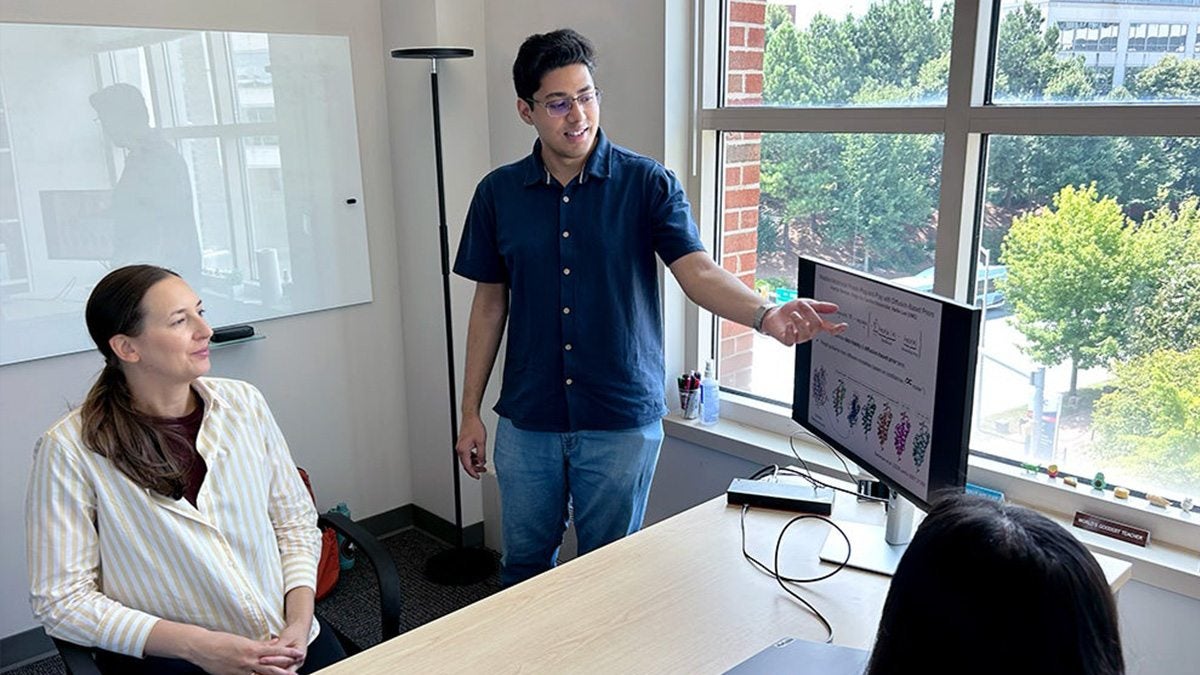
When UNC-Chapel Hill computer science graduate student Amartya Banerjee began a summer internship at Carnegie Mellon University, he didn’t expect it would lead to a published research paper or a major milestone for Carolina’s AI Acceleration Program. But thanks to a creative idea, strong mentorship and financial support from the AIAP, that’s exactly what happened.
Banerjee’s project focused on designing proteins — tiny building blocks that help our bodies to function. Scientists often use electron microscopes and computer models to figure out how these proteins are shaped, which is important for things like developing new medicines. But the imagery and data used to build these models can be messy or incomplete, making it hard to get accurate results.
“You can’t see a protein with your eyes,” Banerjee explained. “But with the right data and tools, you can reconstruct what it looks like. That’s what this project was all about.”
Banerjee’s research made extensive use of UNC Research Computing’s Longleaf shared computing cluster, which is provided at no cost to UNC faculty, students and staff. However, he determined that a more interactive, trial-and-error computing environment was necessary to successfully complete his work.
AIAP funding made it possible
That’s when Harlin Lee, Banerjee’s mentor and an assistant professor in the UNC School of Data Science and Society, learned about the AI Acceleration Program. The AIAP offers computing support through a strategic partnership with Microsoft Azure. The program provides cloud computing credits, essentially giving researchers access to powerful virtual machines in the cloud that can handle big data and complex tasks.
“This was exactly what we needed,” Lee said — not cash but computing capacity.
With help from Lee, Banerjee applied for AIAP funding and received Azure credits to continue his work. He used them to run experiments, refine his model and eventually publish a paper that became the first academic citation for the AIAP.
The paper, co-authored by Banerjee, Lee, assistant mathematics professor Caroline Moosmueller of Carolina and Xingyu Xu, a Carnegie Mellon doctoral student, presents a new approach for integrating multiple scientific measurements, such as distance data and electron density maps, to construct more accurate models of protein structures.
“We combined different types of measurements into one system,” Banerjee said. “That’s not something most models can do, and it helped us build more accurate protein structures.”
AI research at Carolina

See how researchers are working across disciplines to use the technology for the greater good.
Just the beginning
The Azure cloud environment made a big difference. “It allowed me to rapidly test and prototype ideas,” Banerjee said. “I could visualize results in real time, which helped me catch problems early and make better decisions.”
Lee praised Banerjee’s creativity and independence. “We gave him ideas, and he tried them out — but the ideas that ultimately ended up in the paper were mostly his,” she said.
The preliminary results were published after a few months of work, but Banerjee sees this as just the beginning. “The hope is to use models like this for drug design and scientific discovery,” he said. “Not everyone has the resources to train these models from scratch, so learning how to use them effectively is really important.”
With more proposals expected in the coming year and a growing need for computing credits and fellowships, the AIAP is poised to help even more students, educators and researchers turn bold ideas into real-world impact.